[00:29.99]In the night sky, the stars appear to revolve around the Earth, rising in the east, and disappearing in the west.
[00:33.63]The Earth itself seems solid, fixed, and stable, and such common sense perception suggests that the Earth is the centre of the universe.
[00:48.72]This is known as 'geocentrism', with geo meaning Earth, and all pre-modern civilisations drew this conclusion.
[00:57.77]We now know, of course, that the Earth revolves around the sun, and this is called 'helio'centrism', with helio meaning sun, but historically, it took quite a while for this to be deduced.
[01:11.87]As early as the third century BC, an ancient Greek astronomer, Aristarchus of Samos, proposed heliocentrism, but received little support from his peers.
[01:24.31]Similarly, throughout subsequent history, isolated individuals proposed this new idea, but again, no one was listening.
[01:34.04]Geocentrism just seemed too logical to refute.
[01:38.60]Geocentrism also fitted the views of the established Christian church, who could quote biblical passages such as 'the world also shall be stable, that it be not moved'.
[01:51.11]Those who dared disagree were subject to accusations of heresy, often with dire punishments to follow.
[01:59.41]The trouble was, as the night sky was observed more closely, that simple revolution of the stars proved not so simple at all.
[02:09.29]In relation to the other stars, some steadily wandered in given directions, then sometimes reversed for months, and disappeared altogether.
[02:19.13]They were called planets, meaning 'wanderers'.
[02:23.10]In addition, the position of the sun and moon altered slightly over the year, and comets, those mysterious glowing spots, would come and go.
[02:34.28]In order to predict the motion of the planets, and accurately serve the primary purpose of navigation for sailing ships, increasingly elaborate mathematical models were needed-a sure sign that something was not quite right.
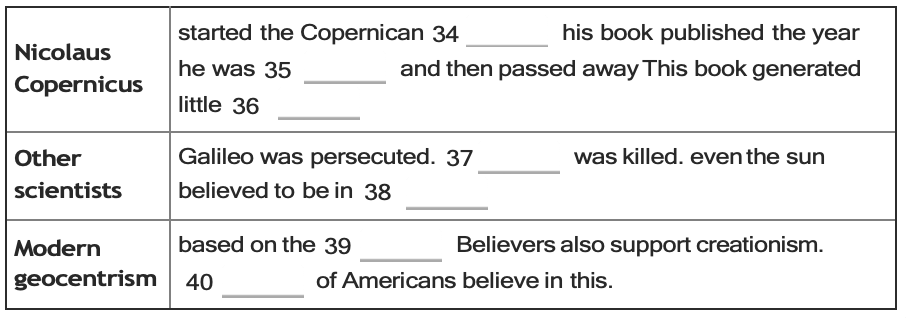
[03:11.57]Heliocentrism, or the belief that the sun is the centre of the solar system, still needed a mathematically-sound description before it could be scientifically accepted, and it was a Polish astronomer, Nicolaus Copernicus, who, in 1543, first published this.
[03:30.05]This event is sometimes referred to as the Copernican revolution.
[03:36.66]Copernicus himself certainly feared the consequences of his proof, knowing full well it might invoke the anger of the established church.
[03:46.58]Probably for this reason, he waited until the last year of his life, when he was sick and dying, to release his findings.
[03:55.29]In addition, the preface of the book, written by a respected member of the church, stated that the model was not necessarily correct.
[04:04.45]As a result of this, there was no 'revolution' whatsoever-in fact, the book received scant attention in the subsequent decades, apart from a few irate clergymen who angrily dismissed the whole scheme as irrelevant.
[04:20.18]Yet the following generations of astronomers did not always fare so well.
[04:25.90]The Italian scientist, Galileo, got into trouble, as did a fellow Italian, with the surname Bruno, Giordano Bruno, who was burnt at the stake, yet ultimately, nothing could slow the spread of heliocentrism across Europe.
[04:41.47]It formed the basis of Isaac Newton's great work on the motion of the planets - a work which implied that even the sun, around which the Earth circled, was itself in motion around a common centre of gravity.
[04:55.98]No discourse about heliocentrism could finish without mentioning that, somewhat unbelievably, there still exists those today who choose to believe that the Earth is the centre of the universe.
[05:08.40]Modern geocentrism is usually the result of literal interpretations of the Bible, which is the cornerstone of these people's beliefs.
[05:17.34]They, therefore, also believe in creationism -- that is, that a God created everything, and while we may smile at this, it is sobering to consider that surveys have revealed that up to 10% of British people, 12% of Europeans, 20% of the USA, and 25% of the Middle East, still hold the belief that the sun revolves around the Earth.
[05:41.83]One can only wonder what Copernicus would have thought of this.